Fittingly for our first Scottish Gothic tale on the list, I spent the day in Edinburgh. I even managed to find a really useful collection of Hogg’s shorter fiction.
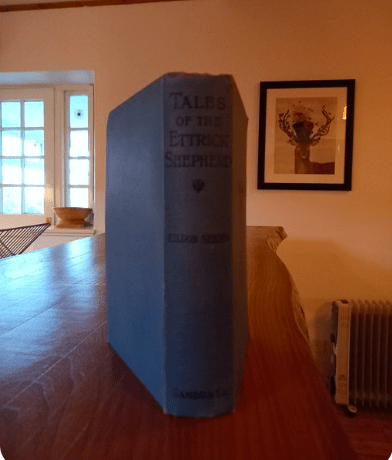
The ‘Ettrick Shepherd’, of course, is James Hogg whose story ‘The Brownie of the Black Haggs’ was our story for Day 7. You can read it here along with two other short stories that are also worth your time! Hogg was a shepherd in his youth and the story we were reading today was one of the collection of pieces in his ‘Shepherd’s Calendar’ which started off as magazine pieces (in Blackwoods) and was eventually published as a collection. This story appeared first in Blackwoods in 1828.
This is one of Hogg’s many stories that deals in something akin to a ‘deil’ (devil). Other stories include, of course, the most famous of Hogg’s work The Private Memoirs and Confessions of a Justified Sinner, along with short stories like ‘Strange Letters of a Lunatic’ and ‘Mr Adamson of Laverhope’. Hogg often mixes folk beliefs and traditions with theological constructions of the demonic. There is an emphasis on perverse theology as demonic: the devilish figure, Gilmartin, in Justified Sinner leads Robert Wringhim into increasingly brutal crimes with extreme Calvinist theology and manipulative scriptural sophistry. This can cross over with more folkloric renderings of the devil in sections like the inset tale of the village of Auchtermuchty who were almost all fooled by the devil and his hellfire preaching of election and perdition. The village was saved by the cunning Robin who lifted the preacher’s robes to reveal ‘cloven feet’. Robin realised something was up though specifically because:
Robin was a cunning man, an’ had rather mae wits than his ain, for he had been in the hands o’ the fairies when he was young, an’ a’ kinds o’ spirits were visible to his een, an’ their language as familiar to him as his ain mother tongue. Robin was sitting on the side o’ the West Lowmond, ae still gloomy night in September, when he saw a bridal o’ corbie craws coming east the lift, just on the edge o’ the gloaming. The moment that Robin saw them, he kenned, by their movements, that they were craws o’ some ither warld than this.
There’s a fascinating mix here of faerie lore and the demonic. The ‘corbie craws’ were of ‘some ither world’, something he knew because of his time with the ‘faerie’, but they are presented as demonic. They regard God as their ‘great enemy’ and fearing that the people of Auchtermuchty might be ‘o’er weel wrappit up in the warm flannens o’ faith’ to be brought down to damnation.
In ‘The Brownie of the Black Haggs’, the emphasis is firmly on the folkloric. Although the local consensus is that the mysterious servant is a brownie although other supernatural options are put forward: ‘a wizard’, ‘a kelpie, or a fairy’. The couple, whose conversation and meeting with both the ‘brownie’ and Lady Wheelhope occupies the later half of the story, have their own suggestions. Bessie Blythe puts the lady’s disappearance down to multiple causes: ‘hasna the deil, or the fairies, or the brownies, ta’en away our lady bodily?’ Devil, fairy, and brownie are offered as distinct yet equal and intertwined options. Her husband Wattie leans more heavily on demonic imagery, referring to Merodach as ‘that Satan of a creature’ and suggesting that ‘the deil was looking after his ain’ in the matter of Lady Wheelhope’s disappearance.
The ‘fiendish creature’ Merodach torments the cruel and violent lady of the house into increasingly desperate acts which lead never to his death or discomfort but rather to her own madness and increasingly traumatic losses. ‘She had better let alone; she will be the first to rue that’, Merodach promises and ever makes true his promise. Is Merodach a divinely ordained force of retribution for her own misdeeds, her posited atheism and her cruel mistreatment of the Covenanters, particularly? (You can find a brief introduction to the Covenanters here or here. It’s a bit too long a history to include in this blog post but it’s worth looking into if you’re interested in Scottish Gothic as they come up a lot!) Was his purpose a more personal form of vengeance? Or was he simply a wicked spirit/creature whose delight was to torment? Perhaps, he’s just a man who thrives on the evil of others as it gives him license for his own crimes. By leaving the identity and nature of Merodach uncertain, Hogg allows room for multiple interpretations.
The image that never quite leaves my mind with this story is the horrifying description of the lady’s fascination and obsession with Merodach, despite violent ill-treatment, despite every ill she tries to force on him rebounding onto her with double force. An equivocal obsession that last even to the point of her own death.
The lady shook her head, uttered a feeble hollow laugh,
and fixed her eyes on Merodach. But such a look! It almost
frightened the simple aged couple out of their senses. It was not a look of love nor of hatred exclusively; neither was it of desire or disgust, but it was a combination of them all.
Whatever the nature of Merodach, the true horror of this story lies in the reality of what Lady Wheelhope becomes in every sense of the word. There is a terrible cruelty to this scene. And once read, it never really leaves you.
 Romancing the Gothic
One thought on “Day 7 ‘A Scare a Day’ – ‘The Brownie of the Black Haggs’ by James Hogg”