Everyone knows Arthur Conan Doyle for his Sherlock Holmes but, of course, he wrote a lot more widely than that! Some of his work is non-fiction defences of spiritualism, short story collections, novels, plays and war poetry. He was incredibly prolific. Among the genres that he dipped into, horror and the Gothic frequently appear. Today’s story ‘The Terror of the Blue John Gap’ (1910) can be read here and it’s a fairly classic cave horror.
Doyle sets his story near Castleton in Derbyshire and his ‘Blue John Gap’ was almost certainly inspired by the ‘Blue John Cavern’ which you can still visit to this day (check out their website). The cavern is named after the mineral ‘Blue John’, a rare semi-precious mineral which is only found around Castleton. There are stories of mining going back to Roman times although those are not quite so certain as Doyle’s story suggests. Dr Trevor Ford in his book Derbyshire Blue John notes that the earliest source for this story of Roman mining is the 1843 book Gem of the Peak. The site does have a long mining history though. A little fun fact relating to Doyle and Derbyshire: his first story ‘The Mystery of Sasassa Valley’ (set in South Africa) was published in the Derbyshire Courier in 1879 (one week after it appeared in Chamber’s Edinburgh Journal. So you could say, his ties to Derbyshire run deep… (I apologise).
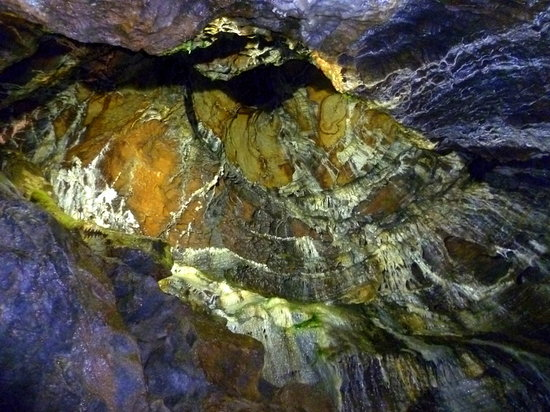
Doyle draws on the existing location to create his own myths. The story, for me, is most effective when he focuses on the cloying feeling of being trapped in the caves, light gone out, lost and listening to something close to you, far too close to you, in the dark. I’m a bit of a sucker for cave horror and possibly the most horrifying part of the story for me is nothing to do with the underground fauna. It’s simply the moment where, after falling in the river, he realises he has no source of light, is in a pitch black cave, and has no idea where he is or how to get out. The fear of getting stuck in a cave system, lost in an unending dark is all a little bit too real!
Doyle combines the claustrophobia of cave horror with the narrator’s little pet theory of a ‘world beneath’. It’s hard not to think of Jules Verne’s Journey to the Centre of the Earth (1864) or even Doyle’s own later work The Lost World (1912). According to the story’s theorising, there is a world under this world, a remnant, a survival, an alternative path for evolution. The best he can imagine erupting from this world is a sort of big fluffy blind cave bear. I don’t know how the ‘reveal’ worked for everyone else but for me, as with so many ‘weird’ tales, the unimaginable horror, the beast beyond description, was a little disappointing. He kept emphasising how light and how hairy it was and it was hard not to imagine it as some sort of inflatable fluff ball. I also have to say that his decision to hunt the creature down seemed pretty unjustifiable. In the end, the ‘gap’ is closed to prevent the creature leaving and it begs the question of why he didn’t just start with that approach. For the good doctor, it appears that hunting large creatures is some sort of test of manliness. He views his decision to wait outside the cave with a gun for an unarmed creature that doesn’t really do him any actual harm as proof that his ‘manhood is at least above reproach.’ Sure the cave bear ‘fell on him’ but the inflatable fluff ball didn’t do any real damage and didn’t seem interested in eating him. I can’t help but feel sorry for the creature. I hope it found its way back to its underground world.
 Romancing the Gothic