Today’s story is ‘Good Lady Ducayne’ by Mary Elizabeth Braddon, who is usually talked about in relation to her sensation and particularly Lady Audley’s Secret (1862). Today’s story can be read here. It was originally published in The Strand with some wonderfully evocative illustrations. I’ll give them to you in order with a little commentary.
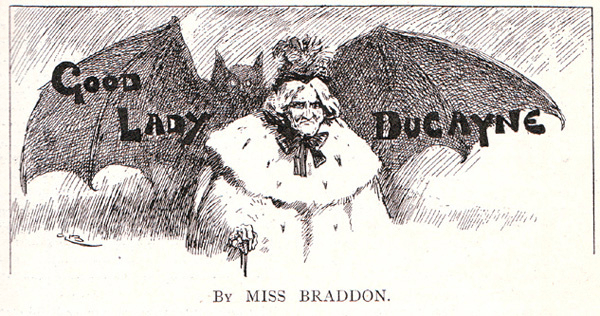
The opening illustration seems to make the vampiric potential of the story clear! Although no definite vampires are found, ‘Good Lady Ducayne’ preys on her companions. The process itself seems quite medicalised – an operation of scalpels and blood transfusion rather than teeth and claw. However, the vampiric nature of the relationship between patroness and companion is clear!
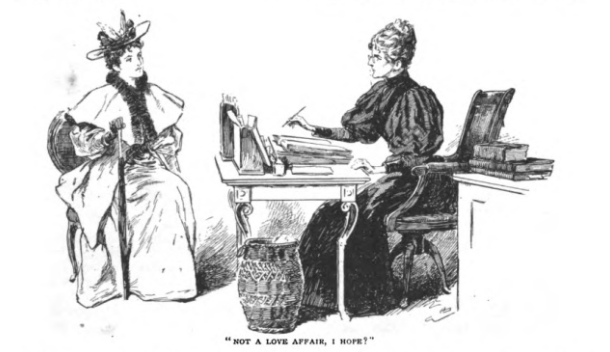
Above, Bella, our heroine, goes to an agency in order to find a job. I have to admit that I hadn’t imagined her dressed in such apparent finery! Bella is a paid companion and in part the story is an exploration of the position of the companion. Like the governesses of the Bronte novels, she inhabits an intermediate position in society, betwixt and between, open to exploitation from above and isolation in every direction. A comment on the story from one of the other ‘challengers’ RW made me think about the way in which ‘the companion’ appears in the Gothic novel. I can’t think of too many examples (so please do add some in the comments) but the one that leaps obviously to mind is the unnamed narrator of Rebecca by Daphne Du Maurier. Her relationship with Mrs. Van Hopper is significantly less tenable that Bella’s appears to be in the story but far less literally vampiric!

Lady Ducayne herself is a quietly compelling villain. She’s a relatively small presence in the most of the story – literally and figuratively. She leaves Bella with copious free time, makes few demands, and seems to generally be a great employer (if only she weren’t so, GASP, old, Bella bemoans). She’s often found hunched over a heat source or resting in the shade. She’s that most dangerous of all villains, the one who looks unthreatening. The one who makes you give them what they want with sweetness, and kindness, and ruthless betrayal. Her final scene, when she throws up her hands, admits wrongdoing and sends Bella and her doctor beau off with a check is chilling for all the right and wrong reasons! I love her lack of guilt, her continued plans for immortality, her complete failure to admit that she did anything wrong. Dying girls and being caught appear to be an inconvenience to her. You have to love a villain who carries all before her so indifferently. The things that gets under my skin with this story though is a trope I have always loathed… The story is called ‘Good Lady Ducayne’ and Bella never changes her opinion on that front. Lady Ducayne has always been a benefactor as far as she’s concerned. She even feels rude for leaving at such short notice. Because NO-ONE TOLD HER what was happening. Herbert Stafford doesn’t seem to think that might be a useful piece of information (nor does he make any attempt to stop Lady Ducayne’s further efforts). Maintaining women’s ignorance to ‘protect’ them is such a common trope and its always gets under my skin. At least in a novel like Dracula, the manly men have to confront what a colossal mistake sending away the ‘little woman’ was, leaving her vulnerable, uninformed and alone when there is a pissed off vampire around (not to mention Mina’s the most competent of any of them) In ‘Good Lady Ducayne’, it feels like it’s meant to be a happy ending that Bella just floats off into her future with no idea what’s happened AND a serial killer is set loose again. I’m not quite sure why Herbert thinks she isn’t going to kill again. Considering she appears to be running through companions at a rate of knots!
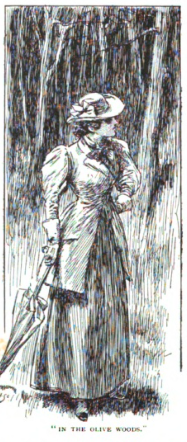
The picture above is the next illustration, seemingly, I presume, showing Bella in her healthy days, striding through the olive woods. She writes home to her mum about them and I have to admit the letter made me laugh a bit. She’s all very ‘oh mum, you would love this, it must be crushing you inside to not be here… let me spend a bit more time telling you how lovely it is and how much you’d love it if only you weren’t POOR’. There are only four uses of ‘olive’ in the story and there’s a nice symmetry to them. The first two, refer to the wild wood walks of Bella in her health; the last two to the olive wood burning on Lady Ducayne’s fire. A fairly perfect metaphor for the way in which Bella’s free outdoor life is being literally burnt away which illustrates her move from outside to in, from free to confined and from healthy to sick.

I joke above about the letters that Bella writes to her mother but the mother/daughter relationship is very much the heart of the novel in many ways. It’s the reason to leave (to help provide for her mother) and the things which leaves her ‘with yearning ever looking westward’ and longing for home. It’s nice to see that although mothers tend to drop like flies in Gothic novels, some survive and, at the mere expense of having a daughter preyed on my a medical vampire, later thrive.
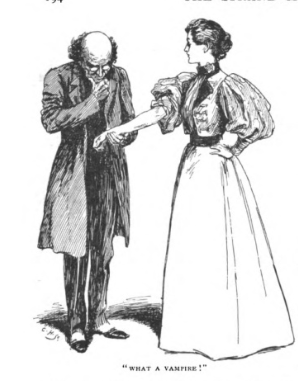
Dr Parravicini is the secondary villain of the piece and another example of hypocrisy at play. Seemingly kind and efficient, its those exact qualities which make him dangerous. There’s something particularly chilling about the process of blood removal. The use of chloroform. The helplessness and complete vulnerability of Bella. The way way in which she is then ‘doctored’ by the self same man who did her harm with her completely ignorant of the fact… I love the illustration caption (and the line in the book). About as heavy handed as you could possibly imagine. This very natural line uttered by a man looking at a mosquito bite/scalpel mark is absolutely the kind of thing that needs a quick turn to the audience and a lengthy eyebrow wiggle. We get it, guys. She’s a type of vampire and Dr Parrivicini is her weird little Igor.
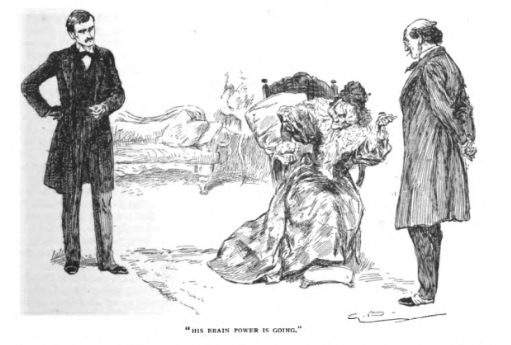
The end scene is where Lady Ducayne’s true malevolence is revealed. I can honestly say I wasn’t expecting her to turn on the doctor. I have to say ‘his brain power is going’ doesn’t seem the nicest (or the wisest) thing to say to the man who’s been doing illegal (and fatal) human experimentation for you for years. I was also surprised that she offered Herbert the job. On the strength of what? He could recognise a scalpel mark wasn’t a mosquito bite. If that’s the bar for her assistants, I do not have high hopes for her immortality.

I’ll leave today’s story and today’s blog with a happy Helen holding up her cheque (literal blood money, I guess) wrapped in an infantilising bubble of ignorance, unaware that anything was ever wrong.
 Romancing the Gothic
Fascinating! I’m thoroughly enjoying these educational daily Gothic story posts!
LikeLike
Thank you! I’m glad 🙂 Some people said they’d like ways to follow or engage with the challenge outside of social media so I thought I’d blog this year. (I didn’t quite take into account how much time it would take, hence being slightly behind!)
LikeLiked by 1 person