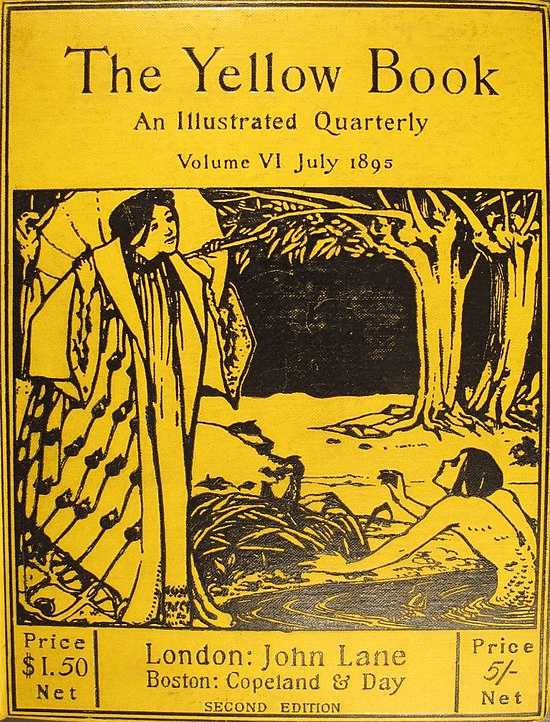
I took the chance today to share one of my favourite writers and one of my favourite stories. Today, we were reading lesser known Northern author (disputed between Yorkshire and Derbyshire) Robert Murray Gilchrist and his story ‘The Crimson Weaver’. You can read the story here. It’s part of a transcription of the original source of the story – The Yellow Book Volume 6 for July 1895. The Yellow Book, was an important literary quarterly magazine in the 1890s, associated with decadence and with the artist Aubrey Beardsley. Gilchrist published in a number of contemporary magazines and was a prolific author, writing over 20 novels, enough short stories for 6 collections, topographical works and at least one play!
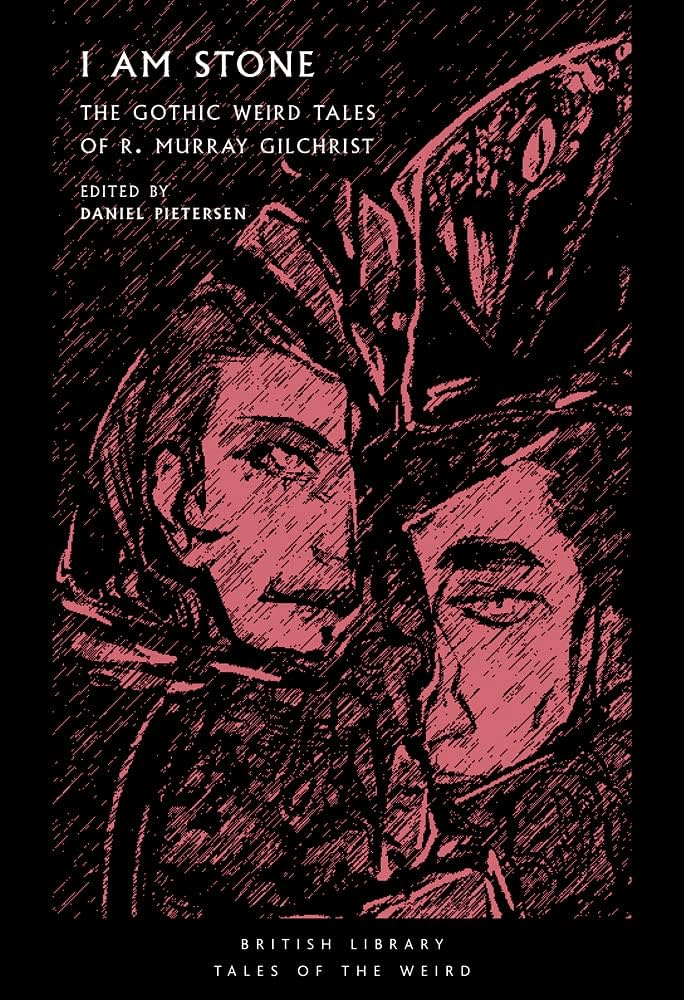
As well as a written version, you can find a recording of me reading this story by candlelight here. If this is your first time encountering Gilchrist and it’s left you intrigued, you should check out of the work of Dan Pietersen. He’s done a couple of introductions to Gilchrist here and here. I’ve done readings of our discussed some of his other stories here (‘The Lover’s Ordeal’) and here (‘The Night on the Moor’). You should also check out the edited collection of Gilchrist stories that Dan Pietersen put together for the British Library ‘Tales of the Weird’ collection.
‘The Crimson Weaver’ is a quasi-vampiric tale (‘The Lover’s Ordeal’ contains a more straightforward vampire). It’s a tale whose language is often baroque, whose allusions (especially to classical and mythological sources) come thick and fast, and whose setting is a disorienting dream-like world. I am never quite sure when or where the story is meant to be set. It seems a strange mix at times of a type of Medieval quest narrative with a maiden/sorceress in a castle, a warning hag on the bridge, a loyal master and his servant or page. But you are then continually wrong-footed in any such assumption. The young ‘servant’ (who calls the older man ‘master’ throughout), turns out to be a young landowner, possessor of the Mansion of Willow Brakes. Various references and descriptions seem to place us more firmly in at least a more recent setting – a classic 19th discussion on the Platonists, the landscape of an 18th or 19th century estate… The story deliberately disorients and places you in a world of dream logic with often abrupt reminders of a less fantastical world. The dreaming logic extends to the inhabitants of the world. Pigs and dogs with human limbs, birds with ‘mannequin’ faces.
The central character is, of course, the endlessly fascinating ‘Crimson Weaver’ herself. As a figure she mixes a host of mythological figures. She draws her life from the blood of men like a vampire. She weaves lives into clothing, a brutal version of the fates weaving the cloth of life. She refers to herself as existing ‘from the beginning’ – a lillith figure of resistance and temptation. The power of Gilchrist’s writing for me is the vivid imagery which bypasses my inability to visualise anything and hits straight at feeling. Rich, shocking, bright and terrible. There is a thrill at her declaration, while she weaves her cloths from the bleeding heart of her last victim, that:
I wear men’s lives
It is perfect in its economy and yet it’s fearful and evocative scope. The closing image, as well, of the loyal friend or lover or servant or pupil or companion (I have never been sure) stays with you long after you close the book
Half-dead, I lie here at the Manor of the Willow Brakes, watching hour by hour the bloody clew ever unwinding from my heart and passing over the western hills to the Palace of the Siren
What an image!
Untangling the skeins of the story itself, its multivalent meanings, its allusions and possibilities is much harder to do (a common feature of Gilchrist’s work). A seemingly simple story of seduction and death becomes something much more intricate in the hands of Gilchrist. I will leave each of you to decide your answers to the questions and disruptions which lie at the root of the story – the temporal discombobulation; the relationship between the two male protagonists; the changing and richly wrought relations of love and loyalty, despair and sacrifice; the spectres of immortality; the queerness (borrowed from Gilchrist’s own life) at the heart of the tale; the very nature of the weaver. I hope you enjoy as much as I do and please do share your thoughts below!
 Romancing the Gothic
I’ve read many vampire anthologies, but have not come across this story before. It’s a stunner!
LikeLike
I’ve read many vampire anthologies, but this story’s new to me. It’s a stunner!
LikeLike
Yes! I love Robert Murray Gilchrist’s tales. I highly recommend the British library collection of his work!
LikeLiked by 1 person